Richard McDonald, the co-founder of McDonald’s, left an estate of about $1.8 million when he died in July 1998 at age 89. That’s roughly $3.5 million in today’s money. He and his older brother Maurice sold the company to Ray Kroc in 1961 for $2.7 million, which came out to about $1 million each after taxes. The man whose name sits above the door of more than 40,000 restaurants never owned a single share of McDonald’s Corporation. Here is how he made his money, what the 1961 sale really involved, and why his fortune stayed small while the brand became one of the most valuable on earth.
What was Richard McDonald’s net worth?
About $1.8 million at the time of his death in 1998. That figure comes from his estate, which is the cleanest measure available for someone who kept his finances private and held no public company stock.

Adjusted for inflation, $1.8 million in 1998 is close to $3.5 million now. It made him comfortable, not rich. He spent his later years in a modest three-bedroom home in New Hampshire and died in a nursing home in Manchester, the city where he was born.
For scale, Ray Kroc, the man who bought the brothers out, died in 1984 with a fortune of around $600 million. McDonald’s Corporation today brings in about $27 billion in annual revenue and operates in more than 100 countries.
Key takeaway: Richard McDonald co-invented fast food, yet his lifetime payout from McDonald’s was about $1 million after tax. Everything after 1961 belonged to Ray Kroc and his shareholders.
How Richard McDonald made his money
Richard was born on February 16, 1909, in Manchester, New Hampshire, to a working-class family. He and Maurice moved to California around 1930, worked odd jobs on movie sets, and ran a small movie theater that barely broke even. Food turned out to be the better bet.
In 1937 they opened a hot dog stand in Monrovia, then in 1940 a drive-in restaurant in San Bernardino called McDonald’s Bar-B-Q. With carhops and a 25-item menu, it soon earned the brothers around $40,000 a year, strong money at the time.
The real breakthrough came in 1948. They shut the drive-in for three months and rebuilt it around what they called the Speedee Service System: a nine-item menu, 15-cent hamburgers, no carhops, and a kitchen laid out like an assembly line. Food came out in seconds instead of minutes. By the early 1950s that single stand was clearing about $100,000 a year in profit.
Franchising followed in 1953, starting with a location in Phoenix. Richard pushed for a building design that would be visible from the road, and architect Stanley Meston drew the golden arches that became the logo. In 1954 a milkshake-machine salesman named Ray Kroc visited San Bernardino, and in 1955 he opened the brothers’ franchise in Des Plaines, Illinois, the first step of the national chain. Under the franchising deal, operators paid 1.9 percent of sales, and 0.5 percent of that went to the brothers.
| Year | Milestone | What it meant for his income |
| 1937 | Hot dog stand opens in Monrovia, California | First steady food business income |
| 1940 | Drive-in opens in San Bernardino | About $40,000 a year with Maurice |
| 1948 | Speedee Service System launches | Around $100,000 a year in profit by the early 1950s |
| 1953 | Franchising begins | Franchise fees plus 0.5% of franchisee sales |
| 1961 | Sale to Ray Kroc | $2.7 million total, about $1 million each after tax |
The 1961 sale to Ray Kroc
The brothers sold everything, the name, the system, and the trademarks, to Kroc in 1961 for $2.7 million. Richard set the price himself: $1 million for each brother after taxes, plus enough to cover the tax bill. Kroc had to borrow heavily to pay it, and the loan’s structure meant it eventually cost him around $14 million to settle.
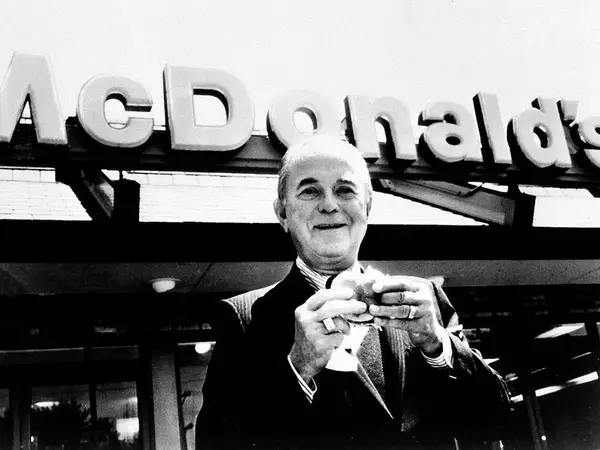
Measured in today’s dollars, $2.7 million in 1961 is roughly $28 million. It was real money, and the brothers said at the time that they were satisfied with it. Maurice was in poor health, neither brother wanted to spend his life flying between franchise openings, and they had already hit their personal goal of making a million dollars before turning 50.
The deal carried one expensive loose end. During negotiations, a half-percent royalty on all future system sales was discussed as part of the brothers’ payout, but it never went into the written contract, and it was never paid. It also carried a sting: the brothers kept their original San Bernardino restaurant but not the right to their own name, so they renamed it The Big M. Kroc then opened a brand-new McDonald’s one block away, and The Big M closed within a few years.
Why he never got richer from McDonald’s
Three decisions locked Richard’s wealth in place. He took cash instead of equity, so when McDonald’s went public in 1965 and its stock began a climb that has never really stopped, he owned none of it. He gave up the ongoing royalty, so decades of growth produced nothing for him. And he sold the physical restaurant business before McDonald’s became, in large part, a real estate company that owns or controls the land under thousands of its locations.
The scale of the miss is easiest to see through that royalty. Systemwide sales across all McDonald’s restaurants now run above $100 billion a year, so a half percent would pay out more than $500 million every single year. Held from 1961 to today, it would have made the McDonald family one of the wealthiest in America.
Richard never described it as a loss. He said more than once that he had no regrets, and that a giant fortune would have bought him little beyond stress, tax problems, and an office in a skyscraper he didn’t want.
Richard McDonald vs Ray Kroc: the money gap
The two men started from the same restaurant and ended in different financial universes. The table below puts the outcomes side by side.
| Richard McDonald | Ray Kroc | |
| Role | Co-founder, co-creator of the fast food system | Franchise agent from 1955, owner from 1961 |
| Payout from McDonald’s | About $1 million after tax in 1961 | Ownership of the entire corporation |
| Net worth at death | About $1.8 million (1998) | About $600 million (1984) |
| Stake after 1961 | None | Controlling shareholder |
Kroc’s side of the story is told openly by the company itself on the official McDonald’s history page, which dates the corporation to his 1955 Des Plaines restaurant. The brothers’ role, from the 1940 drive-in to the 1961 sale, is laid out in detail in the Wikipedia entry on Richard and Maurice McDonald.
His later years
After the sale, Richard moved back to New Hampshire and lived quietly with his wife Dorothy. There were no yachts and no headlines, just a comfortable suburban house and a low profile that lasted almost 40 years.
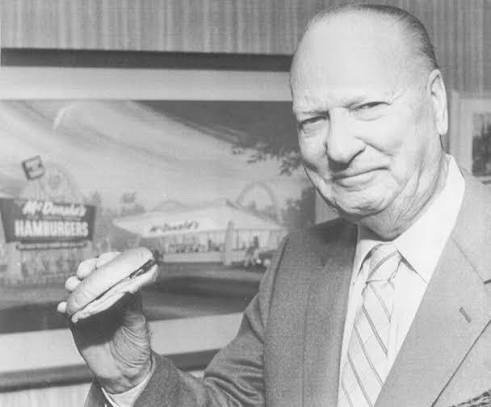
He died of heart failure on July 14, 1998, and was laid to rest at Mount Calvary Cemetery in Manchester. Dorothy died six months later. A wider audience finally met him in 2016, when Nick Offerman played him in The Founder, the film about Kroc’s takeover of the brand. By then the injustice at the center of the story, inventing an industry and collecting a rounding error of its value, had become part of business folklore.
Frequently asked questions
How much did the McDonald brothers sell McDonald’s for?
They sold everything to Ray Kroc in 1961 for $2.7 million, about $1 million each after taxes. In today’s money that is roughly $28 million, split between the two brothers.
Why didn’t Richard McDonald become a billionaire?
Because he sold all rights in 1961 for cash. He held no stock when McDonald’s went public in 1965 and received no royalty afterward, so none of the company’s later growth reached him.
Was Richard McDonald rich when he died?
He was comfortable rather than rich. His estate was worth about $1.8 million in 1998, around $3.5 million in today’s dollars, and he lived in a modest three-bedroom home.
How much would the half-percent royalty be worth today?
More than $500 million a year. Systemwide sales across all McDonald’s restaurants top $100 billion annually, and 0.5 percent of that would flow to the brothers’ heirs every year.
Who ended up richer, Ray Kroc or the McDonald brothers?
Ray Kroc, by a huge margin. He died in 1984 worth about $600 million, while Richard died in 1998 with about $1.8 million and Maurice died in 1971 with a similar modest sum.
Conclusion
Richard McDonald’s net worth at death was about $1.8 million, built on a $1 million after-tax payout from the 1961 sale to Ray Kroc plus the earnings of a very profitable San Bernardino restaurant. He gave up equity and a half-percent royalty that would now be worth over $500 million a year. By his own account, he got exactly what he asked for: a million dollars, a quiet life, and no regrets.
Related Post:
MMR Group Net Worth: What’s Actually Known About the Company’s Value
Banana Loca Net Worth: What the Company Is Actually Worth After Shark Tank
Red Dress Boutique Net Worth: What the Company Is Worth Today
Round21 Shark Tank Net Worth: Valuation, Sales and Where the Brand Stands Now
Sweep Easy Net Worth: What the Shark Tank Broom Company Is Worth Today