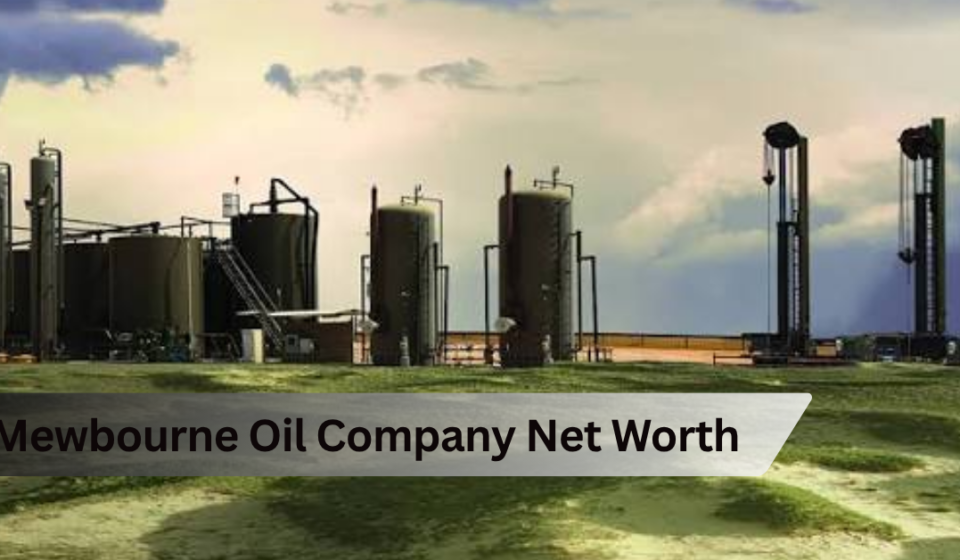

Mewbourne Oil Company has no published net worth, and it will not have one while it stays private. The Mewbourne family owns all of it, no stock trades, and no company-wide accounts are filed for the public to read. What can be measured, though, points to an enterprise value of roughly $15 billion to $30 billion in 2026.
That estimate rests on three things: how much oil and gas the company produces, how many wells it holds, and what buyers actually paid for two nearly identical private Permian companies. Here is the arithmetic, the soft spots in it, and what would move the number.
Why no official figure exists
Mewbourne is private in the strictest sense of the word. No shares change hands. No outside investor is pushing for a valuation. Nothing obliges the company to publish a balance sheet.
The structure is simple. Mewbourne Holdings, Inc. sits at the top and owns two operating pieces: Mewbourne Oil Company, which drills and runs the wells, and Mewbourne Development Corporation, which manages the drilling partnerships that help fund the program. The family holds the whole thing.

For a public company, net worth is a short calculation. Take the share count, multiply by the price, adjust for cash and debt. Mewbourne has none of those inputs. Nobody has ever bought the company, so no market has ever set a price on it. Any number attached to it is an estimate, including the one here.
That leaves one honest method: value it the way an acquirer would, using production and acreage against deals that actually closed.
How big is Mewbourne Oil?
Big enough that scale, not obscurity, is now the story. In 2025 the company produced 575,339 barrels of oil equivalent a day from wells it operates, the second-largest output of any private producer in the United States. Barrel of oil equivalent, usually shortened to boe, is simply a way of adding oil and gas together by energy content so both can be counted in one figure.
It held 4,002 wells and averaged 21 drilling rigs in the first quarter of 2026. That was the heaviest rig program of any private operator in the country, and more rigs than several large public producers were running.
Two areas carry the business. The Delaware Basin, in Eddy and Lea counties in New Mexico and across the state line into Loving and Reeves counties in Texas, is the oil side and where most of the capital goes. The Anadarko Basin, spanning the Texas Panhandle and western Oklahoma, produces more gas and supplies steadier, cheaper volumes.
Growth has been steep. Permian crude output ran near 75,000 barrels a day at the start of 2019 and reached about 210,000 barrels a day entering 2023, most of it added while other producers were pulling back.
Curtis W. Mewbourne started the company in 1965 with two secondhand chairs, a desk, and a single employee who made calls from a payphone in the lobby. It marked its 60th year in 2025, still headquartered in Tyler, Texas. The company keeps a short profile of its founder on its own site.
Most staff work nowhere near Tyler. The company runs seven district offices and pushes decisions out to them. Delaware Basin operations are coordinated from Hobbs, New Mexico, and Midland, Texas. Anadarko operations run out of Perryton, Texas, and Woodward, Oklahoma, with the exploration teams for that basin in Amarillo and Oklahoma City. Tyler keeps the corporate functions: accounting, land administration, legal, marketing, and planning.
What the company is worth, step by step
Two 2024 deals give the cleanest yardstick, because both targets matched Mewbourne’s profile: privately held, Permian, oil-weighted, with deep undrilled inventory and no listing.
| Deal | Price paid | Production at the time | Price per flowing boe/d |
|---|---|---|---|
| Diamondback buys Endeavor Energy Resources | $26 billion | About 350,000 to 365,000 boe/d | Roughly $73,000 |
| Occidental buys CrownRock | $12 billion | About 170,000 boe/d | Roughly $71,000 |
Both landed near $70,000 per flowing barrel of oil equivalent per day. Apply that straight to 575,339 boe/d and you get about $41 billion. That is the ceiling, and it is too high for two reasons.
First, operated production is not owned production. The 575,339 figure counts everything flowing from wells Mewbourne runs, including the shares belonging to its drilling partnerships and other working-interest owners. The company’s own net slice is smaller.
Second, Mewbourne is gassier than Endeavor and CrownRock were. Anadarko gas and Delaware associated gas fetch far less per barrel of oil equivalent than Midland Basin crude, and Permian gas at the Waha hub has at times sold for less than nothing when pipelines filled up.

Adjust for both. If the net share sits somewhere around 60 to 75 percent of operated volumes, and the blended multiple falls nearer $45,000 to $65,000 per flowing boe/d than $70,000, the enterprise value lands at roughly $15 billion to $28 billion. Round that to $15 billion to $30 billion, with the upper half looking more likely while oil trades near $90.
| Short version: no verified net worth exists for Mewbourne Oil Company. The defensible estimate is $15 billion to $30 billion in enterprise value, built from what buyers paid for two comparable private Permian producers in 2024. |
One clarification worth making. Enterprise value covers the whole business, debt included. The family’s equity would be that figure minus what the company owes. Mewbourne funds much of its drilling from cash flow and partnership capital rather than heavy borrowing, which suggests the gap between the two is not wide.
Where the value came from
Almost none of it came from buying other companies. Mewbourne grew by drilling, funded out of its own cash flow and money raised from investors in its drilling partnerships. There is no private equity sponsor behind it and no clock running toward an exit, which changes how the company behaves in a downturn.
When prices collapsed between late 2014 and 2016, it scaled back but never dropped below four rigs, and it did not lay people off. The pandemic played out the same way in reverse. While most producers cut spending to protect shareholder payouts, Mewbourne kept drilling into cheap service costs, and its output roughly tripled. In the year to mid-2022 alone it added about 100,000 barrels a day of supply, close to a fifth of the entire increase in United States oil production over that stretch.
Wells drilled at the bottom of a cycle cost less and pay back faster. Doing that repeatedly for sixty years, with no dividend obligation pulling cash out of the business, is the plainest explanation for how a company few people outside the industry can name ended up worth tens of billions.
What the Mewbourne family is worth
Curtis Mewbourne died on June 23, 2022, in Tyler, at 86, fifty-seven years after he started the company. His family kept every share of it.
That decision is why no personal wealth figure gets published either. Fortunes become countable when they turn liquid, usually through stock or cash from a sale. This one never made that conversion.

The contrast next door is instructive. Autry Stephens built Endeavor Energy Resources in Midland and sold it to Diamondback Energy for $26 billion in stock and cash. Once the deal closed, the family’s wealth became public and measurable: Lyndal Stephens Greth and family were placed at $27.4 billion on the 2025 Forbes 400.
Mewbourne’s owners hold assets of a broadly similar order with none of the visibility. The company is not for sale, a position president and chief executive Ken Waits has restated since the founder’s death and again at the 60th anniversary.
Where real Mewbourne figures are public
One slice of the business does file with the government. Since the early 2000s Mewbourne has raised drilling money through a series of limited partnerships named Mewbourne Energy Partners, lettered by year, running from 01-A through 24-A and onward.
Several of these partnerships register with the Securities and Exchange Commission and file annual reports on Form 10-K. Those filings carry audited revenue, reserve estimates, well counts, and plugging liabilities. The 10-A partnership, to take one, sold $73 million of interests to accredited investors at $5,000 apiece.
The catch is scope. Each partnership owns a fractional interest in one program year’s batch of wells. Its accounts describe that slice and nothing more. Stack them all together and you still do not have Mewbourne Oil Company, because the parent keeps its own working interest outside the partnerships. They are a window, not a mirror.
What would change the number
Oil price does most of the work. A producer of this shape is worth roughly what its future barrels are worth, so the estimate moves with the market. West Texas Intermediate traded near $90 a barrel in late July 2026, up sharply through the month as attacks on shipping disrupted supply through the Strait of Hormuz and the Red Sea. At $60 oil the same company is worth several billion less. At $100 it is worth several billion more. The Energy Information Administration’s Short-Term Energy Outlook tracks where those prices are heading month by month.

Gas is the quieter variable. Permian gas often sells at a steep discount to the national benchmark because pipeline capacity out of the basin runs tight. More takeaway capacity lifts the value of every associated-gas barrel Mewbourne produces.
Remaining inventory counts just as much. What buyers paid for Endeavor and CrownRock was mostly payment for undrilled locations rather than current production. Mewbourne’s Delaware acreage is the part of the business carrying that forward value.
Then there is the one event that would settle the question outright. If the family ever sold, a real price would exist and the guessing would stop. Until then, a range is the most accurate answer available.
Frequently asked questions
Is Mewbourne Oil Company publicly traded?
No. There is no ticker and no stock to buy. The Mewbourne family owns 100 percent of the company through Mewbourne Holdings, Inc., and it has stayed that way since 1965.
How much revenue does Mewbourne Oil make?
No audited company-wide revenue figure is published. With 575,339 boe/d of operated production, annual revenue across all the wells it runs comfortably reaches the billions, but the share belonging to Mewbourne itself is smaller than that total.
Who runs Mewbourne Oil Company now?
Ken Waits is president and chief executive. He joined after graduating from the University of Oklahoma and has spent his whole career there, taking the top job before founder Curtis Mewbourne died in 2022.
Was Curtis Mewbourne a billionaire?
Almost certainly, though no verified personal figure exists. He owned a company whose comparable peers sold for $12 billion and $26 billion, and he never took it public or sold a stake.
Could Mewbourne Oil be acquired?
It is an obvious target, with prime Delaware Basin acreage and years of undrilled locations. The family has said repeatedly that it is not for sale, and it declined to sell even during the peak of Permian consolidation.
Conclusion
Mewbourne Oil Company does not publish a net worth because it has never had to. Judged the way a buyer would judge it, on 575,339 boe/d of operated production, 4,002 wells, and prime Delaware Basin acreage, the business plausibly sits between $15 billion and $30 billion. Treat any single precise figure with suspicion. The range, and the reasoning behind it, is the honest answer.
Related Post:
Hilton Family Net Worth: How Much the Hotel Dynasty Is Really Worth
Nana Hats Shark Tank Net Worth: Where the Banana-Hat Business Stands Now
Minus Cal Net Worth: What the Shark Tank Fat-Blocker Company Is Worth Now
San Manuel Tribe Net Worth: What the Casino Empire Is Really Worth