

There is no verified figure for Stacey Bendet’s net worth. Alice + Olivia, the fashion company she founded and still runs, is privately held, and neither its valuation nor her share of it has ever been published.
What can be checked is everything around that gap: how big the business is, who owns it with her, what she has bought, and what she has paid out. Those pieces won’t hand you one clean number. They will tell you what size of fortune is plausible, and why the answer swings so hard depending on two things nobody outside the company knows.
Why there’s no confirmed number
Alice + Olivia is a private limited liability company. US firms of its size and structure don’t file revenue, profit, or shareholder lists with the SEC. There are no quarterly results, no audited accounts open to the public, and no obligation to announce it when someone buys or sells a stake.
Working out a founder’s wealth needs two inputs: what the company is worth, and what percentage of it she holds. Both are private. Everything else, including her homes and her side ventures, is small change next to that one stake.
Three events would put a real number on the table: an outright sale, an outside investment at a stated valuation, or a public listing. None of those has happened. Until one does, the company’s value is a matter of opinion rather than record.
How Stacey Bendet made her money
She made it by building one brand and holding on to a large piece of it. Bendet taught herself graphic and web design at the University of Pennsylvania and was doing that work when she went looking for a pair of trousers that fit properly, could not find them, and decided to make her own.
In 2002 she showed a 20-piece collection of pants to a room of industry people and celebrities at the Russian Tea Room in New York. The trousers were cut slim through the hip to make legs look longer, and they sold. The brand’s name comes from the founders’ mothers. Bendet’s mother is Olivia.
The early business was wholesale, which is the cheap way to grow. Other people’s shops carried the risk and the rent. Her first own-name store did not open until 2005. By 2015 there were 32 stores, more than 400 staff and about $200 million in annual revenue, with retail sales up 132 percent and profits up around 400 percent over the previous three years. That combination, an owner-operator who never took the business public and never sold it outright, is what makes her worth talking about in wealth terms at all.
How big is Alice + Olivia?
The brand has run at roughly $200 million a year in sales for about a decade. That is a serious business, and still a long way from the scale of a heritage luxury house.
Today the label runs more than 60 of its own boutiques across the US, the UK and Asia, and sells through around 800 department and specialty store accounts, including Saks Fifth Avenue, Neiman Marcus, Bergdorf Goodman, Harrods and Lane Crawford.
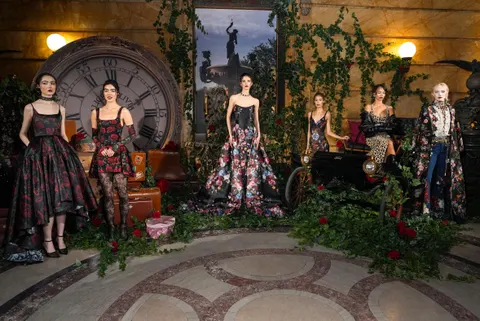
Pricing sits in the contemporary bracket rather than true luxury. A polo top runs about $190. A silk evening gown reaches roughly $1,895. That matters for valuation, because contemporary brands live on volume and wholesale, which usually means thinner margins than a label selling $6,000 coats to a smaller crowd.
The store openings have kept coming. A 1,450 square foot shop opened on King’s Road in Chelsea, London in May 2025. The Madison Avenue flagship reopened that October, expanded from 1,100 to 2,128 square feet. The first Canadian store opened at Yorkville Village in Toronto in April 2026, at about 2,400 square feet.
Who owns Alice + Olivia?
Bendet co-owns it with Andrew Rosen, the man who founded Theory. She launched the label in 2002 with Rebecca Matchett, a classmate from Penn. Matchett left in 2003, and Rosen came in as her financial partner. The two of them have held the majority ever since.
The two met because Bendet pitched to redesign the Theory website. Rosen passed on the web work, liked her, and told her to stay in touch. He is still hands-on. He was the one who pushed for a bigger footprint on Madison Avenue when the flagship was rebuilt in 2025.
What has never been published is how that majority splits between them, or how much either has given up to other investors across more than two decades. Founders almost always end up holding less than they started with. Whatever Bendet’s percentage was in 2003, there is no reason to assume it is the same today.
What is her stake worth?
Her stake is worth the company’s value multiplied by her share of it, and neither number is public. Here is how fast the answer moves once you change those inputs.
| If the company is worth | She owns 25% | She owns 40% | She owns 50% |
|---|---|---|---|
| $100 million | $25 million | $40 million | $50 million |
| $200 million | $50 million | $80 million | $100 million |
| $300 million | $75 million | $120 million | $150 million |
Those aren’t valuations of Alice + Olivia. They are there to show why any single headline number is really just one cell picked out of a grid.
The two numbers that decide the answer, what the company is worth and how much of it she owns, are both private. Change either one and the total moves by tens of millions.
The grid also cuts both ways. A larger stake in a smaller company can be worth more than a small stake in a big one, and 24 years of running a private business gives an owner plenty of chances to move in either direction.
Two things pull the honest answer toward the lower end. A stake in a private company isn’t cash, and turning it into cash means finding someone who wants a piece of a founder-controlled fashion label. Positions like that usually change hands at a discount to their paper value.
It also helps to separate wealth from income. As founder, chief executive and creative director, Bendet draws a salary and a share of whatever profit the company pays out to its owners. Neither is public, and neither is where the money sits. The bulk of a founder’s net worth is locked inside the equity and stays locked until there is a sale.
For a sense of scale, the 2025 edition of Forbes’ ranking of America’s richest self-made women had an entry point of $350 million, up from $300 million the year before. That is the neighborhood a nine-figure claim is asking you to accept.
What else is in her column
Her second business is Creatively, a portfolio and hiring platform for creative professionals that she co-founded in 2020. It raised $5 million in 2021 and another $8 million in 2022, from backers including Thirty Five Ventures and The Tornante Company. A founder’s slice of a company that has raised $13 million is worth something on paper, but it is early-stage and hard to sell.

The property is easier to price. In 2018 Bendet and her husband bought two adjoining apartments at the Dakota on Manhattan’s Upper West Side, one at $9.475 million and one at $5.8 million, then spent roughly three and a half years combining them into a single home. She splits her time between New York and Los Angeles.
That purchase was joint, which matters more than it sounds. Her husband is the film producer Eric Eisner, who runs Double E Pictures and is a partner at The Tornante Company. He is a son of Michael Eisner, the former chief executive of Disney. Household assets and a personal net worth are not the same thing, and a good deal of what gets attached to her name sits on his side of the ledger.
The one hard financial number from 2026
In February 2026, Alice + Olivia, LLC agreed to pay $3.2 million to settle a False Claims Act case brought by the US Attorney for the Southern District of New York. The company admitted it was not eligible for the $2 million second-draw PPP loan it took in January 2021, and the full terms are set out in the announcement from the US Attorney’s office.
The detail is specific. The loan application listed 293 employees, when the true count across the company’s domestic and foreign affiliates was above the 300-employee ceiling for the program. The forgiveness application, filed in February 2022, listed 271.
Two useful things fall out of that. The company employed more than 300 people at the start of 2021, which fits a business of the size described above. And it absorbed a $3.2 million payment in early 2026 without visibly slowing down. Toronto opened two months later.
Frequently asked questions
Is Stacey Bendet a billionaire?
No. Alice + Olivia turns over around $200 million a year, and owning every share of a brand that size would still not reach ten figures. Her wealth sits well below the billion-dollar line.
How much does Alice + Olivia make a year?
Roughly $200 million in annual sales. Profit is not public, because the company is private. It sells through more than 60 of its own boutiques and around 800 department and specialty store accounts worldwide.
Does Stacey Bendet still own Alice + Olivia?
Yes. She is founder, chief executive and creative director, and holds the majority together with Andrew Rosen, who founded Theory and became her business partner in 2003. The split between them has never been disclosed.
Who is Stacey Bendet’s husband?
Eric Eisner, a film producer who runs Double E Pictures and is a partner at The Tornante Company. He is a son of Michael Eisner, the former chief executive of Disney. They married in 2008 and have three daughters.
Where does Stacey Bendet live?
At the Dakota on Manhattan’s Upper West Side. She and her husband bought two adjoining apartments there in 2018 for about $15.3 million combined, then merged them into one home. She also spends time in Los Angeles.
Conclusion
There is no confirmed number for Stacey Bendet’s net worth, because it rests on two private variables: what Alice + Olivia is worth, and how much of it she owns. What is solid is the business itself, a roughly $200 million brand with more than 60 stores and around 800 wholesale accounts, majority-held by Bendet and Andrew Rosen. A fortune somewhere in the tens to low hundreds of millions fits the evidence. Anything more precise than that is arithmetic wearing the costume of reporting.
Related Post:
Anthony Pompliano’s Net Worth: What the Public Filings Actually Show
Chefee Shark Tank Net Worth: What the Robot Kitchen Company Is Really Worth
MMR Group Net Worth: What’s Actually Known About the Company’s Value
Banana Loca Net Worth: What the Company Is Actually Worth After Shark Tank
Red Dress Boutique Net Worth: What the Company Is Worth Today