

Super Potty Trainer has no published net worth. The company is private, it has never released revenue figures after its Shark Tank episode, and the on-air deal with Lori Greiner and Daymond John never closed. The only hard valuation numbers come from the pitch itself: the founders asked for $300,000 for 10 percent, which valued the business at $3 million, and they accepted $300,000 for 50 percent, which valued it at $600,000.
Here is what is actually known about the money, the deal, and where the product stands in 2026.
What is Super Potty Trainer’s net worth?
There is no verified figure. Super Potty Trainer is a small private business, and small private businesses do not file public accounts. Any single dollar amount attached to the company today is a guess, not a number the founders or an investor has confirmed.
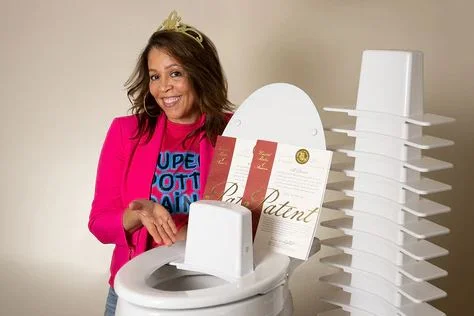
What you can work with are the valuations set on the show. The $3 million ask was based on expected retail orders, not on sales already made. The $600,000 offer was what two experienced investors were willing to pay for half of the company on that day. Since that deal did not go through, no outside money was ever confirmed at that price either.
The safest way to read it: this is a real, still-selling product from a company that has stayed small. The sales figures shared in the pitch point to a business making tens of thousands of dollars in revenue over six months, not millions.
Key takeaway: the $3 million figure was the ask, the $600,000 figure was the offer, and neither one became a closed investment. No confirmed net worth exists for Super Potty Trainer.
What happened on the Shark Tank episode?
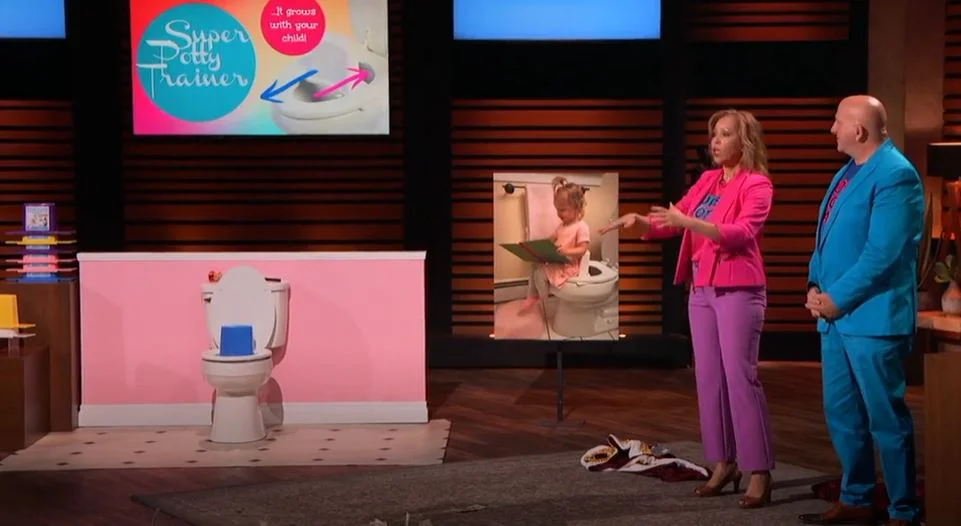
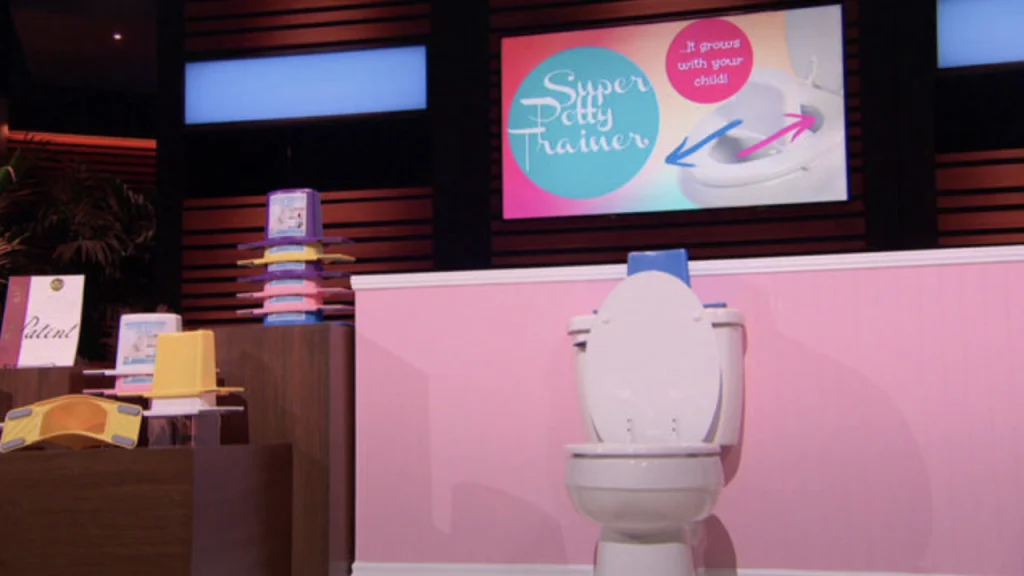
Judy Abrahams and Chris Guerrera pitched Super Potty Trainer in the Season 12 finale (episode 25), which aired in May 2021. They walked in dressed as a queen and a king, calling themselves the Queen of Potty Training and the King of Manufacturing, and asked for $300,000 in exchange for 10 percent of the company.
The product demo went well. Robert Herjavec said right away that it was a great idea, and several sharks talked about their own struggles potty training their kids. The trouble started when the numbers came out.
| Pitch detail | What the founders shared |
|---|---|
| Ask | $300,000 for 10 percent ($3 million valuation) |
| Sales so far | About $65,000 in roughly six months |
| Retail footprint | Just under 400 Walmart stores (356 stores in the sell-through data) |
| Sell-through | About 600 units a month across those stores |
| Cost to make | $2.30 per unit, made in the USA, with a path below $2 at higher volume |
| Retail price at the time | $24.95 |
| Inventory on hand | 3,500 units |
| Pending deals | Talks with Walmart on a $1.1 million order for 4,800 stores; a Menards commitment for 350 stores |
| Final offer accepted | $300,000 for 50 percent from Lori Greiner and Daymond John (split evenly) |
Kevin O’Leary said the company was not worth $3 million and that the founders had come in too early and asked for too much. Mark Cuban liked the product but felt the valuation was built on future orders rather than real sales. Robert called the valuation “nuts.” Daymond pointed out that 600 units a month across 356 stores works out to fewer than two units per store per month, and he questioned the marketing. All three of those sharks went out.
Lori Greiner then said she would only feel comfortable at 50 percent of the company, and Daymond agreed to split the deal with her. Kevin told the founders the offer was better than nothing, Robert agreed, and Judy and Chris accepted on the spot. Judy left the tank in tears, saying she had struggled financially for a long time and that the money would change things.
Did the deal with Lori Greiner and Daymond John close?
No. The on-air handshake never became a signed investment. Two months after the episode aired, the deal was still open, and by late 2022 it was clear it would not close. As of 2026, Lori Greiner and Daymond John own no part of Super Potty Trainer.
This is common. A handshake on the show is the start of due diligence, not the end of it, and a large share of Shark Tank deals fall apart afterward. Sometimes the numbers do not hold up under a closer look. Sometimes the founders decide that giving up half the company is too much once the cameras are off. The founders have not said publicly why this one did not go through.
The practical effect is simple. Super Potty Trainer never received the $300,000, and the company’s value was never set by a real investment.
Is Super Potty Trainer still in business in 2026?
Yes. The product is still sold, but the way it reaches shoppers has changed since the episode. Super Potty Trainer is now sold and supported through Ginsey Home Solutions, a company that manufactures potty training and bath products at its plant in southern New Jersey and supplies most of the big-box retailers in North America. The official Super Potty Trainer site now routes customer service and press questions to a Ginsey email address, and the Amazon listing is sold by Ginsey as well.
The price has dropped a lot. On the show it sold for $24.95. Today the Ginsey Home Solutions product page lists it at $12.98, in blue, pink, and lilac. That is closer to what a standard potty seat insert costs, which makes it an easier buy for a parent comparing options in a store aisle.
For a small brand, landing inside Ginsey’s catalog is a meaningful outcome. It means the product no longer depends on two founders handling manufacturing, shipping, and retail relationships on their own. It also means the business is unlikely to ever publish its own revenue, since it now sits inside a much larger company’s numbers.
How much money has Super Potty Trainer made?
The only confirmed sales figure is the one from the pitch: about $65,000 in roughly six months, all through Walmart. At the $24.95 retail price, that works out to somewhere in the range of 2,600 to 4,000 units, depending on what Walmart paid per unit. The founders also sold 383 of the first 400 units back in 2015, before the business went quiet for a few years.
If the pre-show pace had simply continued, annual revenue would sit around $130,000. The episode gave the brand a bump (the official site still shows reviews from people who bought two or three units right after watching), but there are no public numbers showing how big that bump was or how long it lasted.
Margins were the strongest part of the story. A $2.30 unit cost against a $24.95 retail price is a healthy spread, even after retailer margin. At the current $12.98 price the spread is thinner, though higher volume through Ginsey likely brought the unit cost down.
Who are the founders, Judy Abrahams and Chris Guerrera?
Judy Abrahams invented the product. She was a paralegal in Arizona whose daughter was afraid of falling into the toilet during potty training around 2012. Judy noticed that her daughter would sit if Judy sat behind her, so she built a device that copies that feeling: a curved back support that sits on the toilet rim, under the seat, with silicone pads that keep it from sliding. She did the patent research herself and filed for a utility patent, which she brought into the tank with her. In 2015 she paid for a first run of 400 units and sold nearly all of them.
Chris Guerrera joined after Judy moved to New Hampshire and reached out on social media for business advice. He came from manufacturing, with patents from his time at Ford and experience running BMW plants. His company, Pace Systems, has worked on other Shark Tank products, including Scrub Daddy, Squatty Potty, Drop Stop, and ReadeRest. Judy has said he is the reason they got onto the show.
What does the Super Potty Trainer actually do?
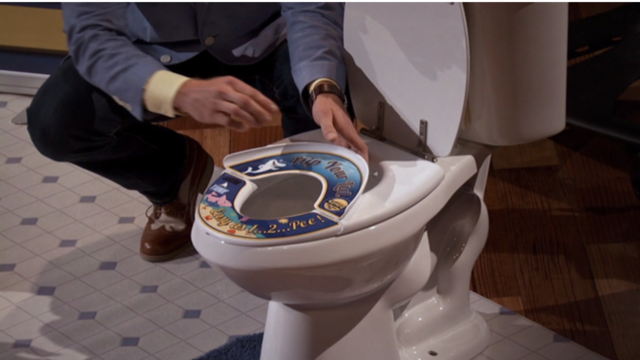
It turns a regular toilet into a child-sized one without a separate seat. You lift the toilet seat, place the trainer on the rim wherever it fits your child’s size, and lower the seat back down. The seat clamps the silicone pads in place, so the trainer does not move. The back support gives the child something to lean on and shrinks the opening so they feel safe. As the child grows, you slide it back. The official Super Potty Trainer site has a compatibility page worth checking before you buy: it works with round and elongated bowls, but the toilet seat needs bumpers that leave a gap for the trainer, and it works best with flat seats.
The point of the design is to skip the floor potty stage. The child trains on the real toilet from the start, which means no separate bucket to empty and no second transition later.
Frequently asked questions
Did Super Potty Trainer get a deal on Shark Tank?
Yes, on air. Lori Greiner and Daymond John offered $300,000 for 50 percent of the company, and Judy Abrahams and Chris Guerrera accepted. The deal did not close after the show, so neither shark ended up investing.
What was Super Potty Trainer’s valuation on Shark Tank?
The founders valued it at $3 million by asking $300,000 for 10 percent. The offer they accepted valued it at $600,000. Since the deal never closed, neither number was ever confirmed by real money changing hands.
Is Super Potty Trainer still available in 2026?
Yes. It is sold through Ginsey Home Solutions and on Amazon for $12.98, in blue, pink, and lilac. The official superpottytrainer.com site is still live and now directs customer service to Ginsey.
How much did Super Potty Trainer sell before Shark Tank?
About $65,000 in roughly six months through Walmart, plus 383 units from a first run of 400 in 2015. Those are the only sales figures the founders have made public.
Who owns Super Potty Trainer now?
Judy Abrahams and Chris Guerrera remain the founders, and no shark holds equity. The product is now manufactured, sold, and supported by Ginsey Home Solutions, though the exact terms of that arrangement have not been made public.
Conclusion
Super Potty Trainer has no confirmed net worth. The $3 million figure was the founders’ ask, the $600,000 figure was the offer they accepted on air, and the deal never closed, so no investment ever locked in a value. The product is still on sale in 2026 at $12.98 through Ginsey Home Solutions, which is a solid outcome for a mom-invented product with $65,000 in early sales. Treat any exact dollar figure for the company as an estimate, not a fact.
Related Post:
SoaPen Net Worth: What the Shark Tank Soap Pen Company Is Worth
Roominate’s Shark Tank Net Worth: What the Company Was Really Worth
Anthony Pompliano’s Net Worth: What the Public Filings Actually Show
Chefee Shark Tank Net Worth: What the Robot Kitchen Company Is Really Worth
MMR Group Net Worth: What’s Actually Known About the Company’s Value